Improve your putting consistency, alignment, and tempo with top-rated golf putting aids designed for home practice, indoor mats, or on-course greens. This guide highlights five proven tools that help players develop repeatable strokes, eye alignment, and precise aim. Whether you’re a beginner or a seasoned player, these aids offer features like mirrors, gates, adjustable paths, and portability to fit any practice routine.
| Product | Key Benefit | Why It’s Useful |
|---|---|---|
| WHYGOLF Putting System & Putting Thing | All-in-one training | Combines mirrors and gates to reinforce setup, eye position, and face alignment. |
| KINGTOP Golf Putting Mirror | Precise alignment | Compact mirror with portable design and tees included for practice flexibility. |
| Genuine EyeLine Alignment Putting Mirror | Visual feedback | Built-in mirrors help verify eye and shoulder alignment for repeatable strokes. |
| WINNER SPIRIT Real Swing 300 | Realistic feedback | Swing trainer focusing on impact and trajectory checks to improve form. |
| KINGTOP Ultra Putting Mirror | Advanced customization | Full alignment view with adjustable gates and holes for progressive training. |
The following sections explore each product’s features, how they aid a consistent putting stroke, and practical tips for integrating them into your routine. All five options are well-suited for American golfers seeking measurable improvements on practice greens and indoor mats.
WHYGOLF Putting System & Putting Thing

WhyGolf’s Putting Thing combines multiple learning aids into a single compact tool. The product blends features inspired by putting mirrors and gates to create a versatile training aid focused on stroke accuracy and green reading. Its patent-pending, fully adjustable putter and gate system helps you consistently strike putts in the sweet spot along your intended target line. This aids players in developing a repeatable setup, correct eye position, and proper face alignment. The construction is lightweight yet durable, with a slim 1/16 inch profile made from high-strength aluminum alloy, enabling portable practice without sacrificing stability. The design supports home practice and can be used on a practice green to reinforce fundamentals in real-world conditions.
Practical use tips: start with alignment and setup, then integrate target line practice using the gates. Focus on getting putts to roll true along your intended line and gradually incorporate tempo changes. This tool is especially useful for players who want a comprehensive, all-in-one solution without buying multiple separate aids.
KINGTOP Golf Putting Mirror

The KINGTOP Classic Putting Mirror provides precise alignment feedback for eye, stance, and putter face. Its lightweight, portable design makes it easy to practice anywhere, whether indoors on a putting mat or outdoors on an actual green. The mirror helps golfers verify that their eyes are over the ball and that their shoulders align with the target line. The included practice set features five golf tees and a carry bag, enabling quick setup and tidy storage. This mirror is ideal for players who want steady alignment cues and simple, repeatable cues to reinforce consistent stroke mechanics during practice sessions.
Practical use tips: place the ball in line with the mirror’s center, check your eye position, then perform a few practice strokes to ensure the face remains square through impact. Use the tees to mark your starting line and create small gates to encourage a straight-back-and-through stroke.
Genuine EyeLine Alignment Putting Mirror

The EyeLine Alignment Putting Mirror is a top training aid recognized on professional tours for its build quality and practical feedback. It includes a built-in stroke path on the mat to guide a repeatable arc, helping players square the face and maintain a consistent tempo. The mirror at the ball position lets players verify eye alignment instantly, a common disruptor of accuracy. A secondary mirror behind the stroke arc provides shoulder alignment feedback, assisting players in correcting posture issues that can derail a putt. This tool emphasizes repeatable mechanics and quick visual feedback to accelerate improvement.
Practical use tips: use the mirror to confirm eyes are over the ball, then practice with a fixed target line. Check shoulder alignment after a few strokes and adjust your stance as needed to keep the posture square to the line.
WINNER SPIRIT Real Swing 300

The WINNER SPIRIT Real Swing 300 is designed to deliver realistic swing feedback and trajectory checks. This training aid emphasizes a true impact feel, helping players understand how their path and tempo affect ball flight. By simulating real swing conditions, golfers can identify swing faults that affect accuracy and distance control. The device supports trajectory checks, allowing players to monitor swing path and adjust accordingly. The trainer targets lower head movement and improved timing, focusing on maintaining a stable, repeatable swing through to impact. It’s particularly useful for practitioners who want tangible, real-world feedback beyond basic alignment cues.
Practical use tips: practice with a pre-shot routine and use the trajectory feedback to adjust swing plane. Pair this trainer with targeted short putts to connect swing improvement with on-green performance.
KINGTOP Ultra Putting Mirror
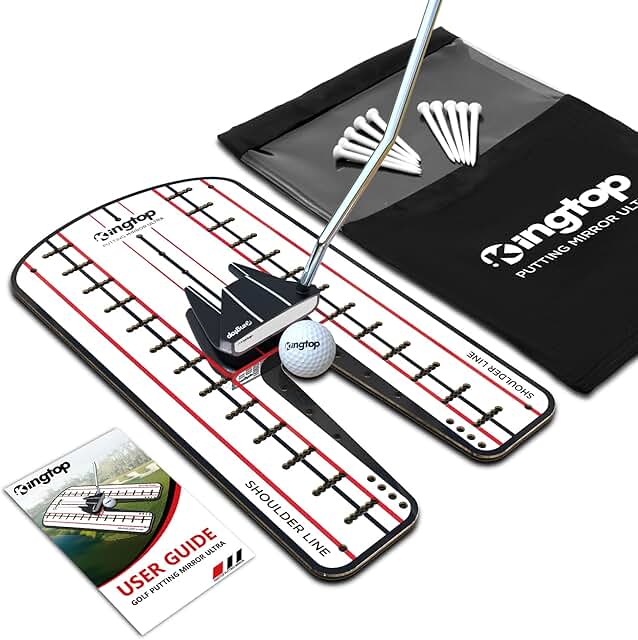
The KINGTOP Ultra Putting Mirror offers a full alignment view for both eyes and shoulders, enabling a comprehensive setup check. Its customizable training gates include multiple hole pairs, providing progressive difficulty as your stroke improves. An advanced stroke control feature includes numerous side holes and top holes to shape backstroke and follow-through paths, helping you build muscle memory for consistent distance control and accuracy. This model is well-suited for golfers who want layered feedback and a scalable practice plan that grows with their skill level.
Practical use tips: begin with a straightforward eye-and-shoulder check, then introduce gates to constrain your path. Increase difficulty by using different hole configurations to challenge consistency and tempo.
Buying Guide
Choosing the right golf putting aid depends on your practice goals, space, and preferred feedback style. Consider these factors to optimize your selection:
- Feedback Type: Visual mirrors provide eye and shoulder cues, while gates and paths offer physical constraints to shape stroke direction.
- Portability: If you travel or practice in different spaces, select lightweight, compact models with carry bags or integrated storage.
- Adjustability: Tools with multiple hole configurations, adjustable gates, or variable stroke paths support gradual progression and long-term use.
- Durability: Aluminum and high-quality plastics ensure longevity under regular practice, reducing replacement costs.
- Space Requirements: Some aids fit on a coffee table or indoor mat; others may require a larger practice green area.
Practical comparison points:
- All-in-one versus modular: All-in-one devices offer breadth of features in a single unit, while modular gates and mirrors let you assemble a custom setup.
- Indoor vs outdoor use: Mirrors and gates designed for indoor mats are typically lighter and more portable, while more robust systems suit outdoor greens.
- Skill level progression: Look for products with multiple training modes or adjustable difficulty to match your improving game.
Implementation tips for best results:
- Begin with baseline assessments of eye position, stance, and stroke path. Use the aids to address the most common issues first, such as alignment or face square at impact.
- Incorporate a consistent pre-shot routine to pair practice cues with in-game behavior, reinforcing muscle memory and rhythm.
- Mix mirror feedback with gate-based drills to develop both setup accuracy and stroke direction; gradually reduce assistance as you improve.